


Quick answer
In the eligible Olist first-review cohort, 0.71% of customers giving one or two stars and 0.99% giving four or five stars placed another delivered order within 90 days. The difference was 0.28 percentage points in one historical marketplace and does not establish a causal effect.
Key findings and sources
The 90-day repeat gap was less than one percentage point
Meet Regulars’ Olist reanalysis found a 0.28-percentage-point 90-day repeat gap between four- or five-star and one- or two-star first-review buyers, with follow-up starting at the review answer.
Olist, Brazilian E-Commerce Public Dataset
22,740 Olist buyers with an eligible first observed delivered order review answered from January through April 2018 and no second delivered purchase before the review Subtract 17/2,386 from 181/18,266 and multiply by 100.
High-rating respondents repeated at about 1% within 90 days
In the historical Olist first-review cohort, 181 of 18,266 buyers giving four or five stars (0.99%) had another delivered order purchased within 90 days of the review.
Olist, Brazilian E-Commerce Public Dataset
22,740 Olist buyers with an eligible first observed delivered order review answered from January through April 2018 and no second delivered purchase before the review Count matched later delivered orders by stable buyer ID and apply the 90-day cutoff.
Low-rating respondents still included repeat buyers
In the Olist first-review cohort, 17 of 2,386 buyers giving one or two stars (0.71%) had a later delivered purchase within 90 days of the review response.
Olist, Brazilian E-Commerce Public Dataset
22,740 Olist buyers with an eligible first observed delivered order review answered from January through April 2018 and no second delivered purchase before the review Group qualifying reviews by score and count purchases after response, through day 90.
Only 217 of 22,740 eligible first-review buyers returned within 90 days
In the pooled historical Olist reviewed cohort, 217 of 22,740 buyers returned within 90 days. The sample excludes repeat orders placed before the selected first-review timestamp.
Olist, Brazilian E-Commerce Public Dataset
22,740 Olist buyers with an eligible first observed delivered order review answered from January through April 2018 and no second delivered purchase before the review Pool qualifying buyers across all score bands and divide 217 by 22,740.
Compare the results
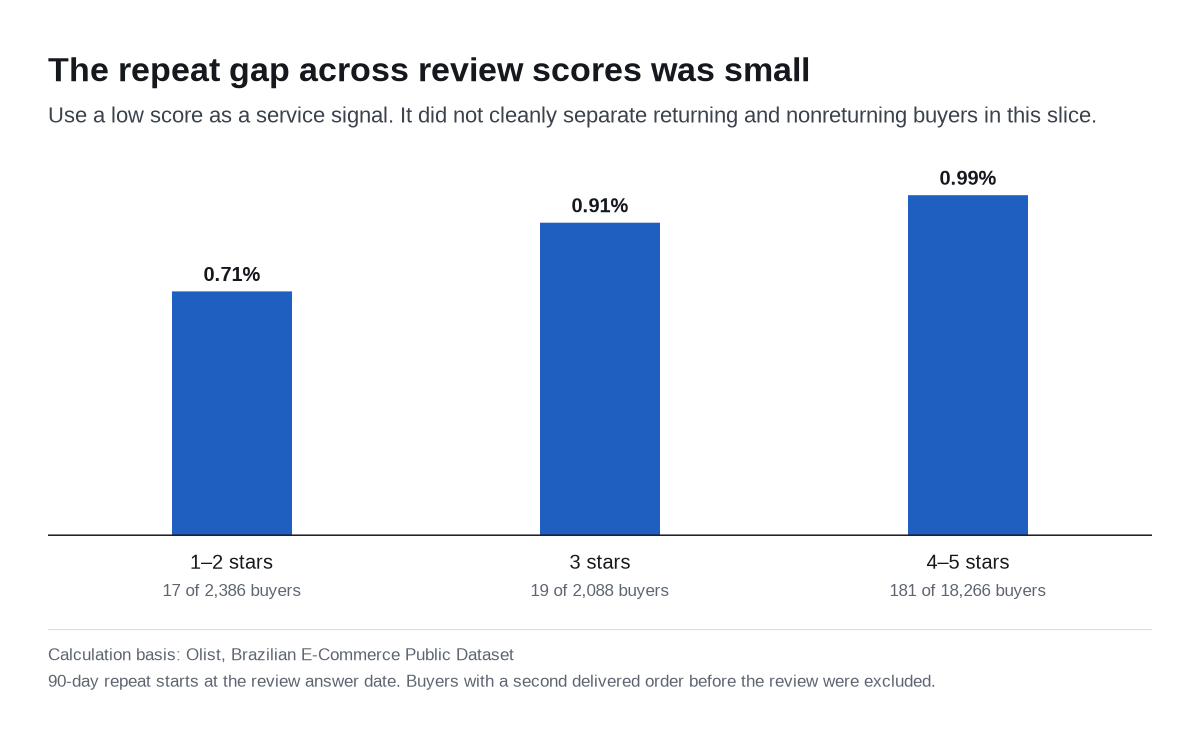
The repeat gap across review scores was small
Use a low score as a service signal. It did not cleanly separate returning and nonreturning buyers in this slice.
Start the follow-up clock after the review
A review can only inform a decision once the buyer has left it. An order placed earlier cannot be a response to that rating. This study chooses the first eligible review for the first observed delivered order and counts orders purchased after the review answer.
The four- or five-star group had 181 of 18,266 buyers return within 90 days. The one- or two-star group had 17 of 2,386. The modest absolute gap is more useful than a relative lift figure for deciding how many buyers could be affected.
Distinguish a service issue from a targeting score
A low first-order rating can reveal an unresolved delivery or product problem. Treat it as evidence that the customer may need support. The observed difference in later buying is too small and the cohort too selected to support a blanket assumption that those shoppers will never return.
Buyers choose whether and when to leave a review. Product type, prices and prior off-platform relationships can affect the score and the later purchase. The analysis does not isolate those factors.
Join feedback, orders and action timing
Store the review timestamp with the resolved buyer ID and the order to which the feedback relates. If a review identifies an unresolved issue, resolve or route that issue before sending a routine reorder message. Record the outcome without treating every recovered purchase as evidence that the original rating was corrected.
For testing a different follow-up sequence, freeze the eligibility criteria at the review event and start observation there. Compare similarly eligible buyers with and without the follow-up, and keep support outcomes alongside purchase outcomes.
Study data
| Measure | Value | Context |
|---|---|---|
| 1–2 stars eligible reviewed buyers | 2,386 buyers | Original first-review count |
| 1–2 stars buyers returning in 30 days | 8 buyers | Original follow-up count |
| 1–2 stars buyers returning in 60 days | 11 buyers | Original follow-up count |
| 1–2 stars buyers returning in 90 days | 17 buyers | Original follow-up count |
| 1–2 stars 90-day repeat rate | 0.71% | Original recomputed share or rate |
| 3 stars eligible reviewed buyers | 2,088 buyers | Original first-review count |
| 3 stars buyers returning in 30 days | 5 buyers | Original follow-up count |
| 3 stars buyers returning in 60 days | 14 buyers | Original follow-up count |
| 3 stars buyers returning in 90 days | 19 buyers | Original follow-up count |
| 3 stars 90-day repeat rate | 0.91% | Original recomputed share or rate |
| 4–5 stars eligible reviewed buyers | 18,266 buyers | Original first-review count |
| 4–5 stars buyers returning in 30 days | 76 buyers | Original follow-up count |
| 4–5 stars buyers returning in 60 days | 137 buyers | Original follow-up count |
| 4–5 stars buyers returning in 90 days | 181 buyers | Original follow-up count |
| 4–5 stars 90-day repeat rate | 0.99% | Original recomputed share or rate |
What changes when you compare the figures
| Comparison | Result | Calculation |
|---|---|---|
| 1–2 stars 90-day repeat rate | 0.71% | = 17 / 2386 * 100 |
| 3 stars 90-day repeat rate | 0.91% | = 19 / 2088 * 100 |
| 4–5 stars 90-day repeat rate | 0.99% | = 181 / 18266 * 100 |
| 4–5 star minus 1–2 star repeat rate | 0.28 percentage points | = (181 / 18266 - 17 / 2386) * 100 |
| All review respondents repeating in 90 days | 0.95% | = 217 / 22740 * 100 |
| 4–5 star minus 1–2 star 30-day repeat rate | 0.08 percentage points | = (76 / 18266 - 8 / 2386) * 100 |
Methodology and sources
Keep delivered orders and group them by customer_unique_id. Select the first observed delivered order by purchase timestamp. Among the reviews for that order, choose the earliest answer timestamp between delivery and 14 days after delivery, breaking ties with review_id. Keep review answers from January through April 2018 and exclude buyers whose next delivered order had already been purchased by the review timestamp. Compare later delivered order purchase timestamps against fixed 30-, 60- and 90-day windows from the review answer. Group ratings one or two, three, and four or five.
Download the source data (CSV)
Download the calculations (CSV)
Download the citation notes (CSV)
Download the evidence behind the new findings (CSV)
Related reading
Repeat customer statistics and the impact of order-level IDs
Repeat purchase statistics across six follow-up windows
Repeat customer value statistics and how sales concentrate
Ecommerce cancellation statistics and how gross value can mislead
Sources and definitions
Olist, Brazilian E-Commerce Public Dataset
The source data includes the population, period, denominator and limitations for every figure.