


Quick answer
In a historical public retail ledger, 44.60% of buyers with ten or more distinct stock codes on their first observed invoice bought again by day 90, compared with 27.69% for buyers with one. The 16.91-point gap narrowed to 8.65 points among first baskets from £50 to under £150.
Key findings and sources
Wider first baskets had a higher observed repeat share
In Meet Regulars’ public UCI Online Retail analysis, 44.60% of 1,139 buyers with ten or more merchandise stock codes bought again by day 90, compared with 27.69% of 65 buyers with one code.
Daqing Chen, Online Retail, UCI Machine Learning Repository
The difference shrank at comparable initial spend
In the UCI cohort, the 90-day gap between the ten-plus and one-code groups was 16.91 percentage points overall and 8.65 points within first merchandise baskets of £50 to under £150. The narrower comparison included 104 and 20 buyers.
Daqing Chen, Online Retail, UCI Machine Learning Repository
A later invoice date separates repeat from same-day billing
The public workbook analysis retained 1,546 identified buyers whose first positive invoice included a matching merchandise stock code. A repeat required a later positive invoice on a separate calendar date.
Daqing Chen, Online Retail, UCI Machine Learning Repository
A substantial share of later repeats came after day 30
Among 969 buyers with ten or more first-invoice stock codes who had yet to repeat by day 30, 338, or 34.88%, made a first later purchase from day 31 through day 90.
Daqing Chen, Online Retail, UCI Machine Learning Repository
The UK-only 90-day repeat gap was 18.47 points before a spend restriction
In the UCI ledger, 45.45% of UK buyers with ten or more first-invoice codes bought again by day 90, versus 26.98% with one code, a 18.47-point difference.
Daqing Chen, Online Retail, UCI Machine Learning Repository
UK first invoices from the fixed January to April 2011 UCI entry cohort. Use first invoice country, distinct stock-code band, and a later positive invoice on a separate date.
The UK-only gap narrowed within the £50 to under £150 first-basket band
In the UK-only UCI subset, 35 of 99 buyers with ten or more codes repeated by day 90 versus five of 20 buyers with one code. The difference was 10.35 percentage points in the £50 to under £150 band.
Daqing Chen, Online Retail, UCI Machine Learning Repository
UK first invoices within the specified positive merchandise value band. Divide each group’s 90-day later buyer count by its eligible first-invoice count.
Compare the results
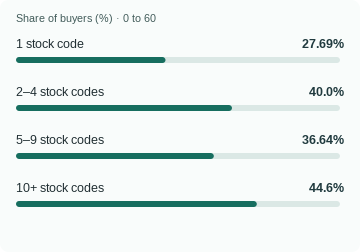
The first basket can tell you what the customer is shopping for
A buyer who orders one item may be replacing something specific. A buyer who tries several products may be exploring the range or buying inventory for a business. Those possibilities suggest different messages. Basket breadth is an observable signal the team can test without assuming it represents a customer’s motive.
The workbook records a first observed invoice, which may not be a buyer’s first purchase ever. Counting later purchases on a different date avoids interpreting a second same-day invoice as a meaningful return. We include a fixed follow-up window for every buyer in the analysis.
The basket-size gap shrinks within a spending band
Among the 1,139 buyers with ten or more distinct codes, 508 bought again by day 90. Among 65 buyers with one code, 18 did so. The difference was 16.91 percentage points. The two groups also had different median first-basket values, £324.05 and £99.50.
Limiting both groups to first merchandise baskets from £50 to under £150 reduced the gap to 8.65 points. This check leaves 104 buyers in the wider-basket group and 20 in the one-code group. A smaller observed gap suggests spend and buyer mix deserve attention. The comparison does not isolate the effect of adding items to an order.
Choose a segment before customers have had time to return
A retention team can define first-order product count and first-order spend at the same moment. Compare bands that have enough buyers and keep replenishable goods apart from one-off gifts or wholesale orders. If the group differences persist through time, randomize a second-order message within the group and leave part of it on the normal schedule.
Measure later paid orders or margin per assigned buyer. Use the original order and observed eligibility as the denominator. If a segment shows an early natural repeat pattern, test whether the message adds orders or mostly reaches buyers who would already have come back.
A geography check changes the estimated gap without settling the cause
Among UK customers in the historical ledger, 460 of 1,012 buyers with ten or more qualifying codes on the first invoice returned by day 90. Among the 63 buyers with one code, 17 returned. That is 45.45% versus 26.98%, a 18.47-point difference. Restricting to first merchandise baskets from £50 to under £150 yields 35.35% versus 25.00%, a 10.35-point gap.
The narrow-basket sample outside the UK contains only two eligible buyers. That makes the outside-UK comparison uninformative here. The UK sensitivity uses a substantial subgroup for broad baskets and a much smaller group for one-code baskets. It shows the pattern survives a UK-only restriction, with a smaller difference at similar spending. It cannot establish whether basket breadth changes later purchasing.
Use the first invoice as a hypothesis for merchandising and timing
For a single-code buyer, a relevant next message might explain fit, restocking or how to use the item. A broader basket could reflect a buyer exploring the collection, buying a gift set or ordering for a business. Distinguish those uses from the number of codes. A merchant can test a more specific proposition within a fixed group, such as a refill reminder for replenishable one-code baskets.
Use the earliest observed invoice and check that fees, inserts and bundle components do not inflate the count. Keep price and distribution market explicit. If a narrow group has very few buyers, combine adjacent bands that lead to the same action or wait for a later cohort. Then randomize messages within the chosen band. A difference that survives multiple descriptive splits still needs a comparison that establishes incremental orders.
Study data
| Measure | Value | Context |
|---|---|---|
| Full cohort, 1 distinct stock codes, buyers | 65 buyers | Eligible first invoice groups use positive lines and a distinct stock-code pattern |
| Full cohort, 1 distinct stock codes, median first merchandise value | 99.5 GBP | Eligible first invoice groups use positive lines and a distinct stock-code pattern |
| Full cohort, 1 distinct stock codes, later buyers by day 30 | 6 buyers | Eligible first invoice groups use positive lines and a distinct stock-code pattern |
| Full cohort, 1 distinct stock codes, later buyers by day 90 | 18 buyers | Eligible first invoice groups use positive lines and a distinct stock-code pattern |
| Full cohort, 1 distinct stock codes, later buyers by day 180 | 34 buyers | Eligible first invoice groups use positive lines and a distinct stock-code pattern |
| Full cohort, 1 distinct stock codes, day 90 repeat share | 27.69% | 18 returned on a later date by day 90 |
| Full cohort, 2–4 distinct stock codes, buyers | 110 buyers | Eligible first invoice groups use positive lines and a distinct stock-code pattern |
| Full cohort, 2–4 distinct stock codes, median first merchandise value | 119.385 GBP | Eligible first invoice groups use positive lines and a distinct stock-code pattern |
| Full cohort, 2–4 distinct stock codes, later buyers by day 30 | 18 buyers | Eligible first invoice groups use positive lines and a distinct stock-code pattern |
| Full cohort, 2–4 distinct stock codes, later buyers by day 90 | 44 buyers | Eligible first invoice groups use positive lines and a distinct stock-code pattern |
| Full cohort, 2–4 distinct stock codes, later buyers by day 180 | 68 buyers | Eligible first invoice groups use positive lines and a distinct stock-code pattern |
| Full cohort, 2–4 distinct stock codes, day 90 repeat share | 40.0% | 44 returned on a later date by day 90 |
| Full cohort, 5–9 distinct stock codes, buyers | 232 buyers | Eligible first invoice groups use positive lines and a distinct stock-code pattern |
| Full cohort, 5–9 distinct stock codes, median first merchandise value | 149.305 GBP | Eligible first invoice groups use positive lines and a distinct stock-code pattern |
| Full cohort, 5–9 distinct stock codes, later buyers by day 30 | 31 buyers | Eligible first invoice groups use positive lines and a distinct stock-code pattern |
| Full cohort, 5–9 distinct stock codes, later buyers by day 90 | 85 buyers | Eligible first invoice groups use positive lines and a distinct stock-code pattern |
| Full cohort, 5–9 distinct stock codes, later buyers by day 180 | 122 buyers | Eligible first invoice groups use positive lines and a distinct stock-code pattern |
| Full cohort, 5–9 distinct stock codes, day 90 repeat share | 36.64% | 85 returned on a later date by day 90 |
| Full cohort, 10+ distinct stock codes, buyers | 1,139 buyers | Eligible first invoice groups use positive lines and a distinct stock-code pattern |
| Full cohort, 10+ distinct stock codes, median first merchandise value | 324.05 GBP | Eligible first invoice groups use positive lines and a distinct stock-code pattern |
| Full cohort, 10+ distinct stock codes, later buyers by day 30 | 170 buyers | Eligible first invoice groups use positive lines and a distinct stock-code pattern |
| Full cohort, 10+ distinct stock codes, later buyers by day 90 | 508 buyers | Eligible first invoice groups use positive lines and a distinct stock-code pattern |
| Full cohort, 10+ distinct stock codes, later buyers by day 180 | 740 buyers | Eligible first invoice groups use positive lines and a distinct stock-code pattern |
| Full cohort, 10+ distinct stock codes, day 90 repeat share | 44.6% | 508 returned on a later date by day 90 |
| £50 to under £150 first basket, 1 distinct stock codes, buyers | 20 buyers | Eligible first invoice groups use positive lines and a distinct stock-code pattern |
| £50 to under £150 first basket, 1 distinct stock codes, median first merchandise value | 84.2 GBP | Eligible first invoice groups use positive lines and a distinct stock-code pattern |
| £50 to under £150 first basket, 1 distinct stock codes, later buyers by day 30 | 3 buyers | Eligible first invoice groups use positive lines and a distinct stock-code pattern |
| £50 to under £150 first basket, 1 distinct stock codes, later buyers by day 90 | 5 buyers | Eligible first invoice groups use positive lines and a distinct stock-code pattern |
| £50 to under £150 first basket, 1 distinct stock codes, later buyers by day 180 | 9 buyers | Eligible first invoice groups use positive lines and a distinct stock-code pattern |
| £50 to under £150 first basket, 1 distinct stock codes, day 90 repeat share | 25.0% | 5 returned on a later date by day 90 |
| £50 to under £150 first basket, 2–4 distinct stock codes, buyers | 50 buyers | Eligible first invoice groups use positive lines and a distinct stock-code pattern |
| £50 to under £150 first basket, 2–4 distinct stock codes, median first merchandise value | 94.28 GBP | Eligible first invoice groups use positive lines and a distinct stock-code pattern |
| £50 to under £150 first basket, 2–4 distinct stock codes, later buyers by day 30 | 9 buyers | Eligible first invoice groups use positive lines and a distinct stock-code pattern |
| £50 to under £150 first basket, 2–4 distinct stock codes, later buyers by day 90 | 20 buyers | Eligible first invoice groups use positive lines and a distinct stock-code pattern |
| £50 to under £150 first basket, 2–4 distinct stock codes, later buyers by day 180 | 28 buyers | Eligible first invoice groups use positive lines and a distinct stock-code pattern |
| £50 to under £150 first basket, 2–4 distinct stock codes, day 90 repeat share | 40.0% | 20 returned on a later date by day 90 |
| £50 to under £150 first basket, 5–9 distinct stock codes, buyers | 113 buyers | Eligible first invoice groups use positive lines and a distinct stock-code pattern |
| £50 to under £150 first basket, 5–9 distinct stock codes, median first merchandise value | 116.01 GBP | Eligible first invoice groups use positive lines and a distinct stock-code pattern |
| £50 to under £150 first basket, 5–9 distinct stock codes, later buyers by day 30 | 11 buyers | Eligible first invoice groups use positive lines and a distinct stock-code pattern |
| £50 to under £150 first basket, 5–9 distinct stock codes, later buyers by day 90 | 36 buyers | Eligible first invoice groups use positive lines and a distinct stock-code pattern |
| £50 to under £150 first basket, 5–9 distinct stock codes, later buyers by day 180 | 57 buyers | Eligible first invoice groups use positive lines and a distinct stock-code pattern |
| £50 to under £150 first basket, 5–9 distinct stock codes, day 90 repeat share | 31.86% | 36 returned on a later date by day 90 |
| £50 to under £150 first basket, 10+ distinct stock codes, buyers | 104 buyers | Eligible first invoice groups use positive lines and a distinct stock-code pattern |
| £50 to under £150 first basket, 10+ distinct stock codes, median first merchandise value | 120.625 GBP | Eligible first invoice groups use positive lines and a distinct stock-code pattern |
| £50 to under £150 first basket, 10+ distinct stock codes, later buyers by day 30 | 10 buyers | Eligible first invoice groups use positive lines and a distinct stock-code pattern |
| £50 to under £150 first basket, 10+ distinct stock codes, later buyers by day 90 | 35 buyers | Eligible first invoice groups use positive lines and a distinct stock-code pattern |
| £50 to under £150 first basket, 10+ distinct stock codes, later buyers by day 180 | 56 buyers | Eligible first invoice groups use positive lines and a distinct stock-code pattern |
| £50 to under £150 first basket, 10+ distinct stock codes, day 90 repeat share | 33.65% | 35 returned on a later date by day 90 |
What changes when you compare the figures
| Comparison | Result | Calculation |
|---|---|---|
| Full cohort, 1 distinct stock codes, day 90 repeat share | 27.69% | = 18 / 65 * 100 |
| Full cohort, 2–4 distinct stock codes, day 90 repeat share | 40.0% | = 44 / 110 * 100 |
| Full cohort, 5–9 distinct stock codes, day 90 repeat share | 36.64% | = 85 / 232 * 100 |
| Full cohort, 10+ distinct stock codes, day 90 repeat share | 44.6% | = 508 / 1139 * 100 |
| £50 to under £150 first basket, 1 distinct stock codes, day 90 repeat share | 25.0% | = 5 / 20 * 100 |
| £50 to under £150 first basket, 2–4 distinct stock codes, day 90 repeat share | 40.0% | = 20 / 50 * 100 |
| £50 to under £150 first basket, 5–9 distinct stock codes, day 90 repeat share | 31.86% | = 36 / 113 * 100 |
| £50 to under £150 first basket, 10+ distinct stock codes, day 90 repeat share | 33.65% | = 35 / 104 * 100 |
| 90-day difference, 10 or more versus one code | 16.91 percentage points | = (508 / 1139 - 18 / 65) * 100 |
| Same difference in the £50 to under £150 band | 8.65 percentage points | = (35 / 104 - 5 / 20) * 100 |
| Day 31 to 90 first repeat among day-30 nonrepeaters in the 10+ group | 34.88% | = 338 / (1139 - 170) * 100 |
| UK 90-day repeat share, 10 or more codes | 45.455% | = 460 / 1012 * 100 |
| UK 90-day repeat share, one code | 26.984% | = 17 / 63 * 100 |
| UK full-basket breadth gap | 18.47 percentage points | = (460 / 1012 - 17 / 63) * 100 |
| UK breadth gap at £50 to under £150 | 10.354 percentage points | = (35 / 99 - 5 / 20) * 100 |
Methodology and sources
Read all 541,909 workbook rows. Positive invoices require an identified customer, a non-cancellation invoice number, positive quantity and positive unit price. Select the earliest such invoice by timestamp and invoice number. Count distinct codes matching five digits and optional letters as a reproducible merchandise proxy. Of 1,549 date-eligible buyers, exclude three whose first invoice contains no matching code. Track any later positive invoice on a different day for up to 180 days. The spending band uses positive merchandise line value on the first invoice before cancellations. The comparisons are descriptive and the band does not remove confounding.
Download the source data (CSV)
Download the calculations (CSV)
Download the citation notes (CSV)
Download the reproducible analysis script
Related reading
Repeat purchase statistics across six follow-up windows
Repeat customer value statistics and how sales concentrate
Ecommerce cancellation statistics and how gross value can mislead
Sources and definitions
Daqing Chen, Online Retail, UCI Machine Learning Repository
The source data includes the population, period, denominator and limitations for every figure.